
Leading from Within
Why CEOs and Entrepreneurs Should Trust Their Intuition
In an era where data is king and decisions are increasingly driven by dashboards, algorithms, and predictive models, a quiet force is making a comeback in boardrooms and startups alike: intuition.
A recent study by researchers Leonie Hallo and Tiep Nguyen examines how senior leaders—CEOs, entrepreneurs, and executives—actually make decisions in complex, high-pressure environments. Spoiler alert: it’s not all about spreadsheets.
This post distills the insights from their research into practical takeaways for today’s business leaders who are ready to trust what they feel, not just what they see.
What Intuition Really Is (and What It Isn’t)
Forget the stereotype of intuition as magical or irrational. In leadership, intuition is rapid, experience-based, and subconscious pattern recognition. It’s what happens when your mind connects dots your conscious brain hasn’t caught up with yet.
Think of it as:
- A gut feeling that something’s off, even when the numbers look fine.
- A sudden insight that hits you in the shower or at 3 AM.
- A deep sense of knowing based on years of experience, even if you can’t explain it (yet).
The Science Behind “Just Knowing”
Psychology calls this dual-process thinking:
- System 1 (Intuition) is fast, emotional, and automatic.
- System 2 (Analysis) is slow, logical, and deliberate.
Top leaders don’t pick one—they use both. The key lies in understanding when to lean into each. In the study, most executives started with a gut feeling and then validated it with analysis, or vice versa.
How Leaders Really Use Intuition
The researchers interviewed 34 senior leaders across industries—from construction to finance to healthcare. Here’s what they revealed:
- Most blend intuition and analysis, using gut feeling to start or finalize decisions.
- A few trust intuition entirely, especially in fast-moving or people-centered decisions.
- Some rely on data first, but note that intuition kicks in when clarity is missing.
- Physical cues—tightness in the chest, a stomach drop, a warm sense of “rightness”—often signal intuitive insights.
And when leaders follow these instincts? They rarely regret it.
Intuition Loves Complexity
When a problem is vague, high-risk, or emotionally charged, intuition excels:
- You’re dealing with people, not just numbers.
- There’s no precedent or perfect data.
- The path forward isn’t clear.
In those moments, intuition steps in as your internal compass, offering clarity when logic hits a wall.
A Framework for Modern Decision-Making
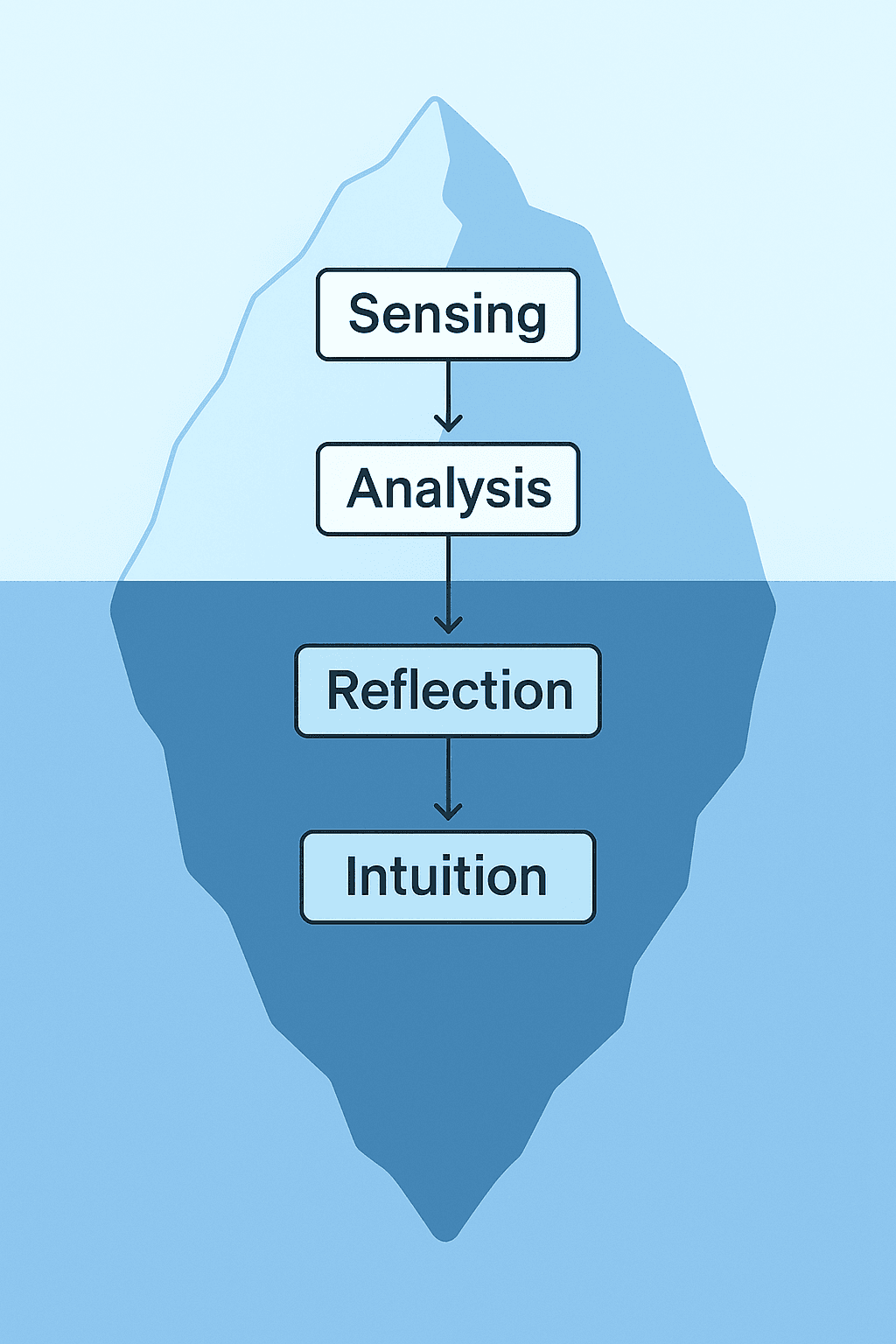
The study proposes an “iceberg model” of decision-making:
- Start at the surface: Scan facts, data, and external inputs.
- Dive below: Reflect, feel, and tune into your subconscious cues.
- Resurface with clarity: Combine both for an aligned, confident decision.
This model encourages executives to intentionally integrate intuition and analysis, especially in turbulent environments.
How to Strengthen Your Intuition as a Leader
- Make space for silence—walk, meditate, unplug. Your best ideas don’t come from being busy.
- Track your instincts – Jot down gut reactions and follow up. What did your intuition get right?
- Learn your signals – Notice where you feel intuition in your body. Is it your chest? Gut? Throat?
- Check your “why” – Is that feeling rooted in experience or emotion? Learn to discern.
- Use it in people’s decisions – Hiring, firing, partnerships—data can’t always see character.
From Paradox to Power: Intuition + Analysis
When your logic says one thing and your intuition says another, you’re not broken—you’re at a creative crossroads.
The paper suggests embracing this paradox. Leaders who do this well:
- Switch between “cognitive gears”
- Use intuition to spark ideas and analysis to refine them
- Stay open to complexity, instead of forcing a binary choice
This isn’t about choosing sides. It’s about becoming ambidextrous in your thinking—leading from the head and the heart.
Why It Matters Now More Than Ever
In a world of AI, automation, and overwhelm, the competitive edge isn’t more data—it’s better judgment.
And judgment, as this research shows, is as much felt as it is calculated.
So if you’re an entrepreneur staring at a fork in the road, or a CEO wrestling with a people problem no KPI can solve, pause. Ask yourself not just, What do I know? But also, what do I sense?
If you’re ready to make smarter, more confident decisions by reconnecting with your intuition:
- Reflect daily on recent decisions—what felt right, and why?
- Create space in your week for stillness and insight.
- Encourage your team to voice gut concerns—not just charts and forecasts.
These are two out of three vital aspects of decision-making. While I haven’t yet explored the third essential element, emotional intelligence, I invite you to stay tuned for the next blog, where we’ll delve into its powerful role in shaping our choices.
Want help integrating intuition into your leadership style or team culture? Let’s talk.
👉 Reach out for executive coaching designed for intuitive, values-based decision-making.
What's in for you, in the package:
3 months of personalized coaching
Hybrid coaching and mentoring sessions
Goal and objective setting
Action plan development
Emotional intelligence coaching
Ongoing support via WhatsApp
Reference: MPI – Holistic View of Intuition and Analysis in Leadership Decision-Making and Problem-Solving
Leonie Hallo 1,* and Tiep Nguyen 2